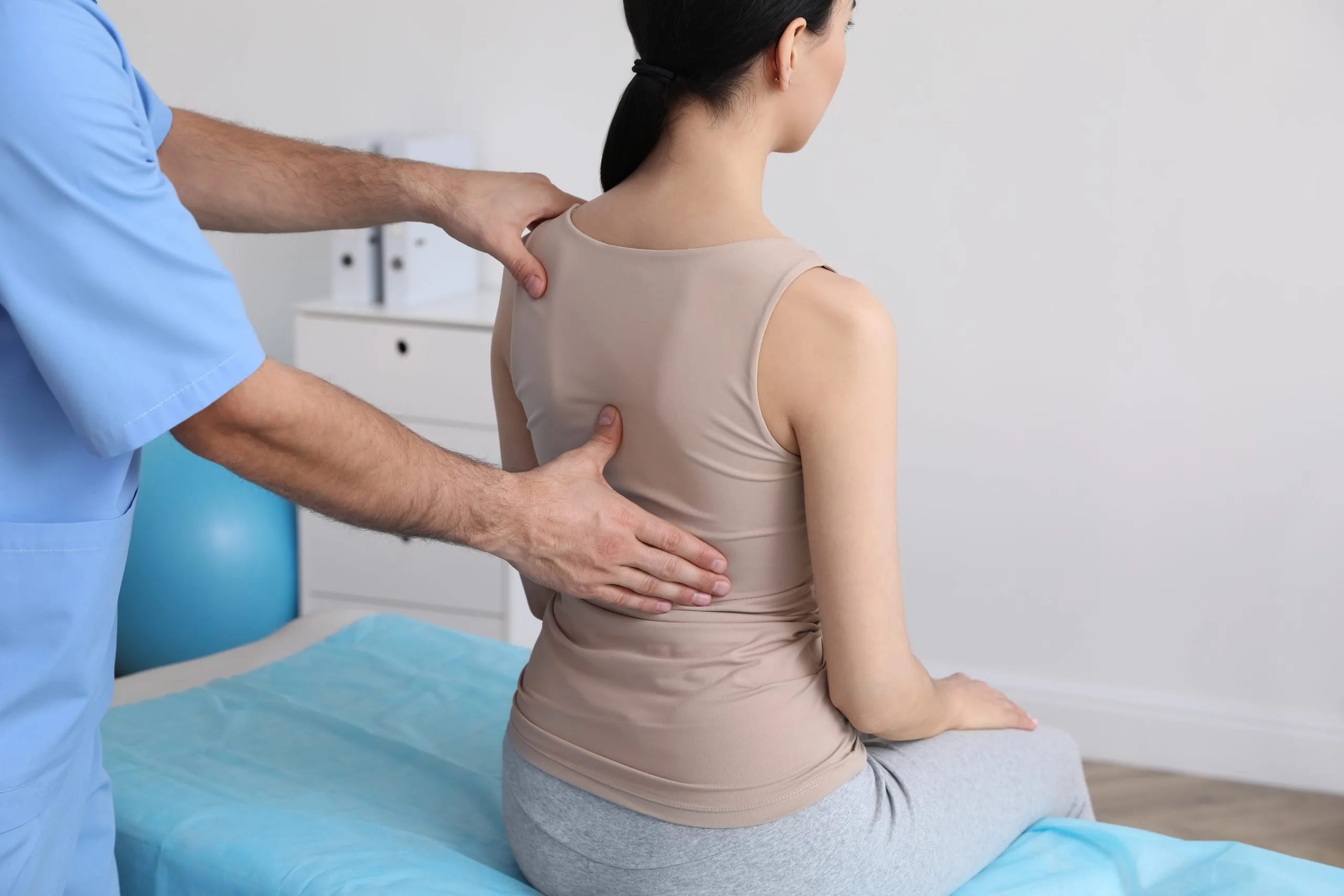
For most people with a herniated disc, bulging disc, sciatica, or chronic low back pain, non-surgical spinal decompression is the reasonable first step. Surgery is usually reserved for progressive nerve damage, loss of bladder or bowel control, severe instability, or symptoms that do not improve after a genuine trial of conservative care.
Decompression is non-invasive, requires no anesthesia, and does not permanently change the structure of your spine – so trying it first rarely closes any doors. Below, we walk through how each approach works and who tends to do well with each.
Non-surgical spinal decompression uses a motorized traction table to gently separate the vertebrae and reduce pressure on spinal discs and the nerves that exit between them. You lie on the table fully clothed while the system applies controlled, cycling traction to a targeted segment of your spine.
The goal is to create negative pressure inside the disc – a vacuum effect that does two things:
Helps retract bulging or herniated disc material. The suction effect can pull displaced disc material back away from the nerve it is irritating.
Promotes healing. Negative pressure improves the flow of water, oxygen, and nutrient-rich fluid into the disc – something discs struggle to do on their own because they have very limited blood supply.
What patients value most:
No anesthesia, no incisions, no downtime. You walk in, complete your session, and go back to your day.
Sessions are short. Most people are on the table for a portion of a routine office visit, and many find the sessions relaxing.
It is done in a series. Discs respond to repeated, consistent input over a plan of care – not a one-and-done treatment.
It is usually paired with other therapies. At Palm Beach Health Center, decompression frequently sits alongside corrective chiropractic care, shockwave therapy, functional rehabilitation, dry needling, and corrective exercise – because relieving disc pressure works better when the muscles and movement patterns around the spine are addressed too.
Decompression is commonly used for herniated and bulging discs, chronic back and neck pain, sciatica, degenerative disc changes, facet joint irritation, and certain cases of spinal stenosis.
Back surgery is a broad category, and all of it physically alters the anatomy of your spine. Common procedures include:
Discectomy: Surgical removal of the herniated portion of a disc.
Laminectomy: Removal of a small piece of bone from the back of a vertebra (the lamina) to widen a narrowed canal and create space for the nerves.
Spinal Fusion: Permanently connecting two or more vertebrae to eliminate painful motion and treat instability or severe degeneration.
Some procedures are minimally invasive; others are major operations. What they share is permanence, which means:
Recovery takes weeks to months, not days, and often requires extensive physical therapy or rehabilitation regardless of how well the surgery goes.
Fusing one segment shifts mechanical demand to the segments above and below it over time.
Surgery addresses structure, but it does not automatically fix the movement habits, muscle imbalances, or postural patterns that contributed to the problem.
That last point matters more than most people realize. Palm Beach Health Center regularly sees patients whose chief complaint is nerve pain that persists after a back surgery – a reminder that a successful operation and a pain-free life are not always the same thing.
Decompression tends to be the stronger first option when:
Your pain is disc-related, but nerve function is intact. Pain shooting down a leg, tightness, or intermittent numbness – while strength, reflexes, and control remain. This is the classic candidate.
Imaging shows a bulge or herniation without severe compression. Many discs look dramatic on MRI and still respond well to conservative care.
You have sciatica. Pain radiating down the leg from pressure on the sciatic nerve can often be relieved at its source in the lower back.
You have degenerative disc disease. Decompression helps rehydrate discs that have lost height and hydration, easing chronic pain and stiffness.
You have posterior facet syndrome. Gently stretching the spine unloads the small joints connecting the vertebrae and reduces irritation.
You have failed back surgery syndrome. For patients with ongoing pain after a previous surgery – without hardware such as screws or rods – decompression can offer non-invasive relief.
Your symptoms fluctuate. Worse with prolonged sitting or bending, better lying down – that variability suggests a mechanical, pressure-driven problem.
You want to stay active. Our practice is built around drug-free, non-surgical recovery for people who want to keep playing pickleball, golfing, lifting, or chasing grandkids.
Some situations call for prompt medical or surgical evaluation. Seek immediate care if you experience:
Loss of bladder or bowel control, or numbness in the saddle region (inner thighs, groin, buttocks) – possible cauda equina syndrome, a medical emergency involving extreme pressure on the nerve bundle at the end of the spinal cord.
Progressive weakness – a foot that drops, a leg that gives out, a grip that keeps weakening.
Rapidly worsening numbness that spreads rather than fluctuates, or loss of coordination.
Unrelenting pain following significant trauma, such as a serious fall or high-speed collision.
Spinal fracture, tumor, or infection identified on imaging.
Documented spinal instability – vertebrae slipping in a way that threatens the cord or nerve roots, or severe arthritis requiring fusion for structural support.
Failure of all conservative options after a genuine, well-documented multi-month course of care including decompression and corrective chiropractic care.
Published outcomes for both approaches vary widely, and any specific percentage you see online should be read with caution. What the research consistently supports is more useful:
Most episodes of low back pain and sciatica improve without surgery.
Conservative care and surgery often produce similar outcomes at the one- and two-year mark for many disc-related conditions, with surgery sometimes providing faster early relief.
Studies on spinal fusion show a wide range of outcomes, and a significant number of patients still report back pain years later.
Patients who address the underlying movement and strength issues – not just the painful segment – tend to hold their results longer.
Outcomes for both approaches depend heavily on accurate diagnosis and patient selection.
Many patients who complete a full course of decompression at Palm Beach Health Center experience substantial, lasting pain reduction – particularly when it is paired with corrective exercises, chiropractic adjustments, and other supportive therapies. The goal is not just symptom relief but correcting the underlying problem.
The choice between spinal decompression and back surgery comes down to sequencing. Surgery is the right answer for progressive nerve damage, instability, red-flag symptoms, or cases where a genuine trial of conservative care has failed. Both decisions depend on an accurate diagnosis – which is why an exam, imaging, and a real conversation about the findings should come before any treatment plan. For many patients in Royal Palm Beach and West Palm Beach, spinal decompression has been the key to getting their lives back.

About the Author
Dr. Matthew Symons
July 27, 2026